Friday, 28 April 2017

Notes on Amélie

List words that describe Amélie.
- Innocent
- Helpful
- Quirky
- Creative
- Curious
- Quiet
- Introverted
- Shy
- Observant
- Kind
- Lonely
- Caring

Describe three aspects of Amélie's personality.
As a result of Amélie's childhood and the way in which she was raised, she is quite an introverted and shy character, however she proves to also be quite kind and helpful by the fact that she discovered the memory box in her apartment and went to the effort of finding the owner to return it to him. 

What are some differences in this film, compared to a typical Hollywood film?
- The colours of the film are really emphasised, whereas in Hollywood films, they generally are not
- The shot types (high and low angles, zooms, etc.) are really dramatic in Amélie, compared to most Hollywood films


- The storyline of Amélie is very simple, but has been conveyed in a very different and more complex way to Hollywood films
- The type of music is very different
- The overall aesthetic of the film (e.g. colours, etc.), all fit in with the setting (Paris)
- The narration is very different - an example is how each character is introduced with random facts about themselves in Amélie. This would not happen in a Hollywood film
- The way in which Amélie gets the guy in the film is not typical of a Hollywood film as she could have easily just spoken to him, however, she led him on a journey to find out who she actually is
- The characters in Amélie are very unusual and none of them are 'normal', whereas in Hollywood films they are


How are mise-en-scene and cinematography used and is it different to Hollywood films?
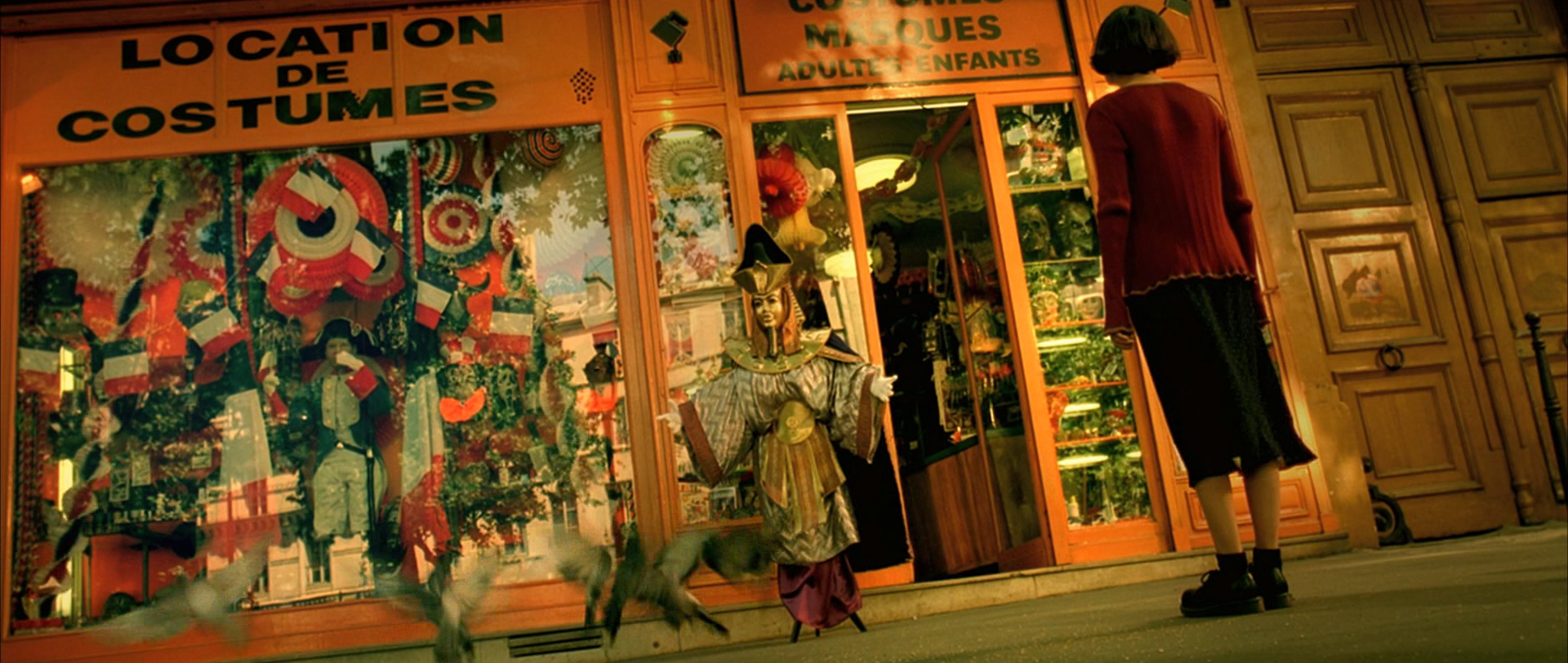
The colour palette used in Amélie is very dramatic, compared to Hollywood films. It mainly focuses on two contrasting colours: red and green, which is uncommon for a Hollywood film.


The lighting used throughout the film differs depending on Amélie's mood: it is brighter when she is happy and darker when she is not (as shown below). This is generally the same with Hollywood films, however, it is not as emphasised in other films compared to Amélie. The majority of the shots are also highly contrasted.


The acting style of the film is very different to Hollywood films, mostly because of how odd and unusual the characters are. They are all very unique, none are 'normal', and this is emphasised through their acting and their dialogue.

Amélie is set in a town near Paris, which is not necessarily unusual for a Hollywood film. However, it is portrayed as very old and traditional in this movie, whereas Hollywood films usually portray it as a very modern city.

The various shot types used throughout the film are very different to regular Hollywood films, mostly due to the extreme close ups and zooms, camera movement, and camera angles. Everything in Amélie seems to be a lot more emphasised than in the film produced in Hollywood.


Wednesday, 26 April 2017

Amélie

In the last few lessons, we have been watching the French film Amélie, directed by Jean-Pierre Jeunet. It's a romantic comedy about a girl who discovers a memory box in her apartment and returns it to its owner; having seen its positive effect on him, she goes on a mission to make others happy and eventually falls in love with a man who collects photo booth pictures and leads him on an adventure to find her.

I really enjoyed this film and I loved the visual style, especially the colours that were used and the types of shots that were taken. I thought the narration of the film was really cool and interesting, especially when introducing all the characters where it said their likes and dislikes. It was quite confusing in the beginning when we started watching it so I wasn't sure if I would like it, however it turned out to be really engaging and I loved it. The shots of Amelie as a child (the first image below) were my favourite.


As shown by the images above, the main colours used throughout the film were red and green. The green has been used to represent hope and contrast with the warmer colours, and red has been used to represent Amélie's personality, love, passion, and young mind.

Sunday, 23 April 2017

Auteurs

An auteur is a film director whose influence on their films is so great that they are considered to be its author.

Auteurs and their signature styles:

Alfred Hitchcock
- Strong visuals, rather than lengthy dialogue
- Use newspaper headlines and stories to aid in narrative
- Suspense, murder, romance, dark humour
- Locations used are not just a background, they are important to the story, e.g. uses shots of American symbols and portrays them as dangerous and menacing, when they are meant to be pure
- Extreme close ups, slow zoom into objects are commonly used in his films
- Emphasis on emotion
- Use of skewed angles, wide shots that end in close ups, long sequences with no dialogue and cause a level of discomfort
- Voyeurism

Martin Scorsese
- Slow motion
- Long tracking shots
- Freeze frame
- Breaking the fourth wall
- Silence
- Often shots of characters looking/talking into mirror

Francis Ford Coppola
- Central character is not brave or heroic
- Long tracking shots
- Focuses on faces and expressions of characters, rather than dialogue
- American Dream, family, brotherhood

The Coen Brothers
- Majority of films are crime dramas
- Crimes gone wrong
- Screaming characters
- Car tension
- Foolish characters
- Yellow and gold tones

Quentin Tarantino
- Shot from inside car boot/where the camera is at a low angle and characters are looking down, towering over the shot
- Uses food to emphasise power
- Stylised dialogue and upbeat music during murder scenes
- Use of crane shots that track over characters
- Hyper-stylised violence
- Strong female leads

Tim Burton
- Gothic colour palettes, production design and costume design
- Peculiar loner characters

Sofia Coppola
- Pastel colours
- Non-verbal techniques
- Languid camera movements
- Modern soundtracks

Wes Anderson
- Symmetrical style
- Overhead shots
- Mostly keeps camera stationary
- Most shots from straight on
- Colour palette

Guy Richie
- High-octane action
- Quick jump cut scenes
- Circular and interconnected plots
- Colourful characters
- Filtered overlays and strong use of colour to depict the mood

Saturday, 22 April 2017

Self-Reflection and Evaluation

Year 12 Film, Television and New Media Documentary Production
Self-Reflection and Evaluation:

Please answer each question using complete sentences, including as much detail as possible to justify your responses.

1. Reflecting on your completed production task:

Are you satisfied with the result? And did it turn out as you had visualised it?
I am mostly satisfied with my third of the film, however, there are a few things that could have been improved or added so that I was completely satisfied. It did not turn out as I had originally visualised it as I had planned for different interviewees and different interview questions to be asked, meaning that the documentary was revolving around different points within the idea of privacy and security. I was not completely satisfied with the completed project as I feel that it could have flowed a lot better if there was better communication with the rest of the group as the styles did not match very well, making it obvious that it was three thirds put together to make one film.

Does the completed documentary feel like one cohesive project and does each individual section reflect the particular aesthetic of your group?
The documentary does not feel like one cohesive project, rather three individual sections. Although, we all have the same/quite similar colour palette of blue and shots that are slightly underexposed with higher contrast which makes it look a bit more cohesive. It could have looked a lot more like one single project if the narrator had been shown throughout the entire film, not just in one section, and if the shots were more similar in the third section, as they are quite different to the rest of the film.

Would you like to change or improve any aspects of your final film (concept, ideology, style, shots, editing, etc.)
With the third of the documentary that I produced, I would have liked to include a bigger variety of shots than just the ones that I have of the phones and laptops scrolling through social media, to make it a bit more interesting. Also,  I would have preferred to have used different music that was a bit more better suited to the documentary, except I had a really hard time trying to find the perfect background music.

If you could start the project again, what would you do differently?
If we could start the project again, I probably would have communicated a lot better with the rest of my group, especially with Ashlee, as this is something that needed a lot of improvement and was probably the reason why our thirds of the documentary looked so different. I would have asked each member of the group to show the others our thirds of the film earlier so that we could all see what everybody was up to for a better idea of the aesthetic, and so that we could give each other some tips. This would have significantly improved the cohesiveness of the documentary. That is probably the only thing I would change as I am quite happy with our time management, my third, etc.

2. Evaluating your production process, respond to the following points:

How did you use the planning documents effectively during production? (shot lists, synopsis and treatment, etc.)
I believe that we used the planning documents quite effectively. I made sure to use the shot list every time that I filmed to ensure that I was organised and didn't waste time trying to think of shots to film, and also so that my third stayed within the time limit. I also used my synopsis/treatment to help me when creating the actual shot list, which definitely helped as I gave a good amount of detail in this.

Were there any problems or difficulties during production and how did this affect your project? (Difficulties may include; shooting, technical, time management, teamwork, absences or editing, etc.)
The majority of the problems that we faced throughout the project are to do with teamwork. We didn't work very well as a team, particularly in communication, as we failed to create three sections of the same aesthetic. Also, for the majority of the project, our schedules really clashed. Ashlee was not available most afternoons, and Eliza was busy with musical rehearsals every single lunch, afternoon and Sunday, making it extremely difficult to find time to film. This meant that I had to film all of my shots for my third at home in the afternoons and we had to fit in our interviews during our media lessons. 

How did other people respond to your rough edit? Did you use their feedback to make changes to the film?
I didn't show others a rough edit as a group project, I just showed my individual section, and it was mostly positive feedback. The main feedback was just that there was no background music (which I later added in), and that the point of the terms and conditions bit was unclear. I later made that point of my argument clear by adding in quotes from various social media sites' Privacy Policies to highlight the fact that the sites take a lot of information from users that they are unaware of as they just scroll to the bottom and press accept.

Discuss whether you undertook adequate and detailed reflection to support your work? (Look at your blog and consider if it looks like a terms worth of work?)
I worked a lot on my blog this term as this is something I really wanted to improve on and not leave to the last minute. I believe that there is an adequate amount of reflections to support my work on the project as I updated it quite regularly, and it is fairly detailed.

3. As this task focused on documentary production explain the specific techniques you implemented which reflect your chosen style (expository, participatory, etc.)
The style that we chose for our documentary is expository, and this is made clear through a number of specific techniques. There is a narrator which makes commentary throughout the film and speaks directly to the audience (and Voice of God), and there is a strong argument that social media has negative affects on teenagers, which has been enhanced through various shots and interviews.

4. Explain some specific documentary techniques which you used to persuade your target audience of your ideological viewpoint.
Throughout the film, there are multiple interviews with figures of authority, which is a documentary technique used to persuade the audience the social media has a negative affect on teenagers, as these people are easily trusted and influential due to their position (University Degrees, Headspace, etc.). Also, statistics have been used which emphasise the argument, and voiceovers explaining the subject help persuade viewers of our argument.